23.2 Lenses


Lenses
| THIN LENSES | |
|---|---|
| Focal Length | f = ½R R = radius of curvature |
| Thin Lens Equation | 1/p + 1/q = 1/f p = object distance q = image distance • When q > 0, the image is real. • When q < 0, the image is virtual. |
| Magnification | m = hi / ho = -q / p hi = image height ho = object height • When m > 0, the image is upright. • When m < 0, the image is inverted. • When |m| > 1, the image is larger than the object. • When |m| < 1, the image is smaller than the object. |
| Lens Power | P = 1 / f measured in Diopters; f must be in meters |
| Spherical Aberration | Imperfect image quality due to variation in focal distance for light rays passing through a lens farther from the principal axis. |
| Chromatic Aberration | Imperfect image quality due to variation in the index of refraction for different wavelengths of light. Different wavelengths will form an image at slightly different locations. |
| PRINCIPAL RAYS (Thin Lenses) | |
|---|---|
| Incident Ray | Refracted Ray |
| Parallel to the Principal Axis | Through/From the Focal Point |
| Through the Focal Point | Parallel to the Principal Axis |
| To the Principal Axis (Center) | Passes Straight Through |
| CONVEX LENS (CONVERGING) | |
|---|---|
| p > f | p < f |
| • Real, Inverted Images • Magnification increases as p approaches f | • Virtual, Upright Images • |m| > 1 |
| CONVCAVE LENS (DIVERGING) | |
| • Virtual, Upright Images • m > 0, m < 1 • f < 0 | |
| IMAGES | |
|---|---|
| q + | real |
| q - | virtual |
| m + | upright |
| m - | inverted |
| |m| < 1 | smaller |
| |m| > 1 | larger |
| MIRROR/THIN LENS EQUATUION SUMMARY | |||
|---|---|---|---|
| Mirror/Lens | p | q | f |
| Concave MirrorConverging Lens | + | + when p > f - when p< f | + |
| Convex MirrorDiverging Lens | + | - | - |
Combinations of Thin Lenses
| COMBINATIONS OF THIN LENSES | |
|---|---|
| Magnification | m = m1 × m2 |
| • The image from the first lens is treated as the object for the second lens. | |
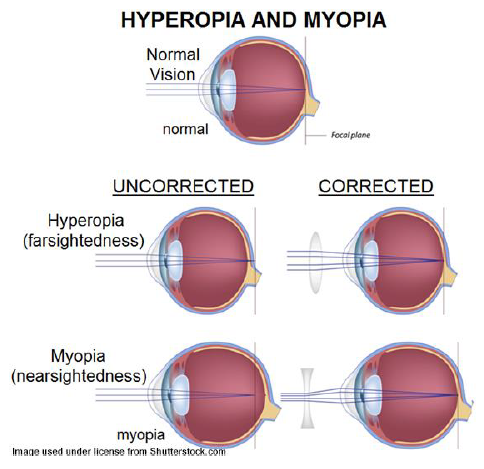
The Human Eye