2.1 Displacement, Velocity, and Acceleration


Displacement (Δx)
Displacement is a vector whose magnitude is equal to the change in position between two points and also has a direction associated with it. In contrast, distance is a scalar, having magnitude but no direction. You might view the magnitude of the displacement as the straight-line distance between two points irrespective of any path taken to travel between them.
Velocity
v = Δx / Δt
vavg = vi+vf / 2
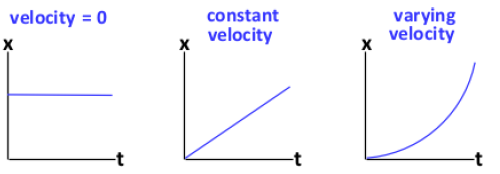
Velocity is a vector whose magnitude is equal to the change in the position over the change in time and also has a direction associated with it. In contrast, speed is a scalar and is equal to the magnitude of the velocity.
The instantaneous velocity is equal to the slope of a line tangent to the curve of position vs time.
Acceleration
a = Δv / Δt
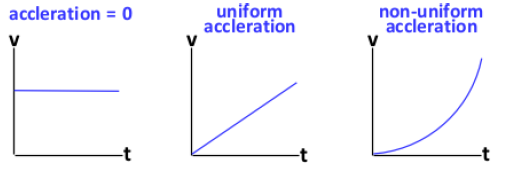
Acceleration is a vector whose magnitude is equal to the change in the velocity over the change in time and also has a direction associated with it. If the speed is increasing, the acceleration points in the same direction as the velocity. If the speed is decreasing, the acceleration points in the opposite direction as velocity.
The instantaneous acceleration is equal to the slope of a line tangent to the curve of velocity vs time.