
3.4 Limiting Reagent Calculations



PRE-HEALTH PREP


Limiting Reactant Problems
General Chemistry 3.4
Table of Contents
- What a Balanced Equation Actually Tells You
- 3 Mole Ratios Every Stoichiometry Problem Uses
- How to Solve Stoichiometry Problems Using Moles Only
- Grams-to-Moles Stoichiometry: Converting with Molar Mass
- What Is a Limiting Reactant? The Bicycle Analogy
- How to Find the Limiting Reactant: Step-by-Step Example
- How to Calculate Excess Reagent Left Over
- How to Calculate Percent Yield (Formula + Example)
- 7 Key Takeaways for Limiting Reactant Problems
What a Balanced Equation Actually Tells You
Limiting reactant problems are the culmination of an entire chapter on stoichiometry — and for most general chemistry students, the most challenging stoichiometry topic they will encounter. When students look back after a year of chemistry, limiting reactants and theoretical yield calculations are often the first things they recall, and rarely with fond memories. That changes here.
To discuss limiting reactants, we need a reaction. Consider the industrial synthesis of ammonia from its elements:
The Haber Process (simplified):
N₂(g) + 3 H₂(g) → 2 NH₃(g)
One mole of nitrogen gas reacts with three moles of hydrogen gas to produce two moles of ammonia gas.
Here is a foundational question: looking at that equation alone, how many moles of N₂ are present? The honest answer is: we don't know. A balanced chemical equation never tells you what quantities of reactants you actually have. It communicates one thing only: the mole-to-mole ratio in which reactants combine and products form. Any information about the actual quantities present must be provided separately as given data.
3 Mole Ratios Every Stoichiometry Problem Uses
The coefficients in a balanced equation are the source of every mole ratio you will use in stoichiometry. For the ammonia synthesis reaction, those ratios are:
- N₂ to H₂: 1 : 3
- N₂ to NH₃: 1 : 2
- H₂ to NH₃: 3 : 2
You can form a valid mole ratio between any two species in the equation. If you have 2 moles of N₂, for example, you would need 6 moles of H₂ — a 2 : 6 ratio that reduces to the 1 : 3 ratio from the coefficients. Earlier in stoichiometry you extracted mole ratios from molecular formulas; here you extract them from the coefficients of the balanced equation. In both cases, the ratio describes how things relate, never how much you have.
How to Solve Stoichiometry Problems Using Moles Only
When you already know the number of moles of a reactant, stoichiometry is straightforward: apply the appropriate mole ratio, and you are done. The following examples use convenient numbers to make the process transparent before moving to more realistic calculations.
Example 1: Moles of H₂ Required from Moles of N₂
Given: 6 mol N₂. How many moles of H₂ are needed for complete reaction?
Using dimensional analysis with the 1 : 3 mole ratio:
6 mol N₂ × (3 mol H₂ / 1 mol N₂) = 18 mol H₂
The moles of N₂ cancel, leaving 18 moles of H₂.
Example 2: Moles of NH₃ Produced from Moles of N₂
Given: 6 mol N₂. What is the maximum number of moles of NH₃ that can be produced?
Using the 1 : 2 mole ratio:
6 mol N₂ × (2 mol NH₃ / 1 mol N₂) = 12 mol NH₃
As long as you begin with a known number of moles, a single mole-ratio conversion connects you to any other species in the equation. The complexity increases when the problem provides masses instead of moles.
Grams-to-Moles Stoichiometry: Converting with Molar Mass
Laboratories work with masses, not moles directly. When a problem gives you grams of a reactant, you cannot apply a mole ratio until you first convert to moles. The bridge between grams and moles is always the molar mass.
Converting Grams to Moles Using Molar Mass
Example: Grams of N₂ to Moles of H₂
Given: 56 g of N₂. How many moles of H₂ are needed for complete reaction?
- 1Convert grams of N₂ to moles using the molar mass of N₂ (28 g/mol): 56 g ÷ 28 g/mol = 2 mol N₂
- 2Apply the 1 : 3 mole ratio to find moles of H₂: 2 mol N₂ × (3 mol H₂ / 1 mol N₂) = 6 mol H₂
Extending to Grams of H₂
If the problem asks for grams of H₂ rather than moles, add one more conversion step using the molar mass of H₂ (2 g/mol):
Full Dimensional Analysis Chain
56 g N₂ × (1 mol N₂ / 28 g) × (3 mol H₂ / 1 mol N₂) × (2 g H₂ / 1 mol H₂) = 12 g H₂
The pattern is: grams → moles (via molar mass) → moles (via mole ratio) → grams (via molar mass). The mole-to-mole step in the middle is the only one that uses the balanced equation's coefficients; every other step uses a molar mass.
Tip: Run the entire calculation as a single chained dimensional analysis rather than breaking it into separate steps. This reduces arithmetic errors and makes unit cancellation easy to verify at a glance.
What Is a Limiting Reactant? The Bicycle Analogy
Before tackling a chemical limiting reactant problem, it helps to build intuition with something concrete. Consider this assembly "reaction":
Assembly Equation:
1 frame + 2 tires → 1 bicycle
Mole ratios: frames to tires = 1 : 2; frames to bicycles = 1 : 1; tires to bicycles = 2 : 1
Finding the Limiting Reactant
Suppose you have 10 frames and 22 tires. How many bicycles can you assemble at most?
The method: calculate the maximum product from each "reactant" independently, then choose the smaller result. Whichever reactant produces fewer bicycles will run out first — that is your limiting reactant.
- 10 frames × (1 bicycle / 1 frame) = 10 bicycles
- 22 tires × (1 bicycle / 2 tires) = 11 bicycles
Frames limit production at 10 bicycles. Tires are in excess. When the frames run out, 2 tires remain unused. The theoretical yield is 10 bicycles — the maximum obtainable given the quantities available.
Key Concept: The limiting reactant is not necessarily the one present in smaller quantity by mass or even by moles — it is the one that produces fewer moles of product when you apply the mole ratio. Always let the stoichiometry decide, not a quick glance at the numbers.
How to Find the Limiting Reactant: Step-by-Step Example
Now apply the same logic to the ammonia synthesis. Given 112 g of N₂ and 30.0 g of H₂ that react completely, answer three questions:
- Which substance is the limiting reactant?
- How many grams of NH₃ are produced (the theoretical yield)?
- How many grams of the excess reagent remain after the reaction?
Step 1: Do Not Compare Grams Directly
Common Mistake: Students often look at 112 g vs. 30.0 g and assume H₂ must be limiting because there is less of it. This reasoning is flawed. The 1 : 3 stoichiometric ratio is a mole ratio, not a gram ratio. A well-crafted exam problem will almost always be designed so that the reactant present in smaller mass is actually the one in excess. Always convert to moles first.
Step 2: Calculate Theoretical NH₃ from Each Reactant
From N₂:
112 g N₂ × (1 mol N₂ / 28 g) × (2 mol NH₃ / 1 mol N₂) = 8 mol NH₃
(112 ÷ 28 = 4 mol N₂; 4 × 2 = 8 mol NH₃)
From H₂:
30.0 g H₂ × (1 mol H₂ / 2 g) × (2 mol NH₃ / 3 mol H₂) = 10 mol NH₃
(30.0 ÷ 2 = 15 mol H₂; 15 × 2/3 = 10 mol NH₃)
Step 3: Identify the Limiting Reactant and Theoretical Yield
The nitrogen supplies enough for 8 moles of NH₃; the hydrogen supplies enough for 10 moles. The reaction can only proceed to whichever limit is reached first: N₂ is the limiting reactant, and the theoretical yield is 8 mol NH₃.
To express the theoretical yield in grams, apply the molar mass of NH₃: nitrogen contributes 14 g/mol and the three hydrogens contribute 3 g/mol, for a total of 17 g/mol.
Theoretical Yield in Grams:
8 mol NH₃ × (17 g / 1 mol NH₃) = 136 g NH₃
The term theoretical yield reflects the fact that real reactions rarely achieve this maximum. Side reactions consume some reactants, and most reactions do not proceed fully to completion, so the actual product collected is almost always less than the theoretical value.
How to Calculate Excess Reagent Left Over
The final — and most error-prone — part of a limiting reactant problem is determining how much of the excess reagent remains after the reaction. The logic is simple: find out how much of the excess reagent was actually consumed in producing the theoretical yield, then subtract that from the starting amount.
Example: Grams of H₂ Remaining
Starting material: 30.0 g H₂
Theoretical yield: 8 mol NH₃
- 1Convert moles of NH₃ produced to moles of H₂ consumed using the 3 : 2 ratio: 8 mol NH₃ × (3 mol H₂ / 2 mol NH₃) = 12 mol H₂
- 2Convert moles of H₂ consumed to grams: 12 mol H₂ × (2 g / 1 mol) = 24 g H₂ consumed
- 3Subtract from the starting mass: 30.0 g − 24 g = 6.00 g H₂ remaining
Most Common Mistake: Students calculate how much H₂ is consumed and report that as the answer, forgetting to subtract from the original amount. The question asks what is left over — that is always the starting amount minus the amount consumed. Never skip the subtraction step.
How to Calculate Percent Yield (Formula + Example)
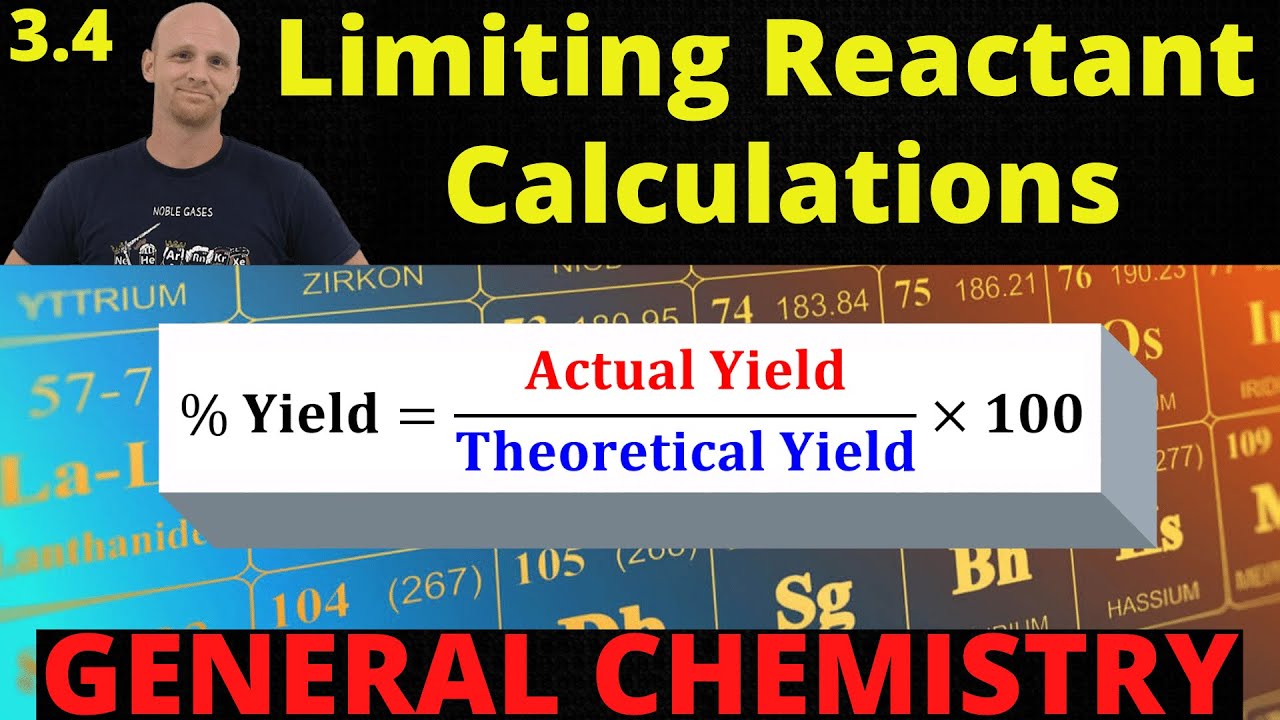
The theoretical yield represents the best possible outcome under ideal conditions. In practice, side reactions, incomplete reactions, and physical losses during product isolation all reduce the amount of product actually collected. The percent yield quantifies how close the actual result came to the theoretical maximum:
Percent Yield Formula:
% Yield = (Actual Yield / Theoretical Yield) × 100
This equation contains three variables. Given any two, you can solve for the third.

Percent Yield > 100%? If an actual yield exceeds the theoretical yield, something is wrong. In organic chemistry lab, this almost always means the isolated product is wet — residual solvent or water is adding to the measured mass. The product needs to be dried more thoroughly. You cannot physically produce more product than the stoichiometry allows.
Example: Percent Yield Calculation
Using the ammonia synthesis problem above, the theoretical yield is 136 g of NH₃. Suppose the experiment actually produces 102 g. Think of it this way: if you were sent out with enough money to buy 10 pizzas and returned with 8, you delivered 80% of what was expected. The same logic applies here:
Percent Yield Calculation (in grams):
% Yield = (102 g / 136 g) × 100 = 75%
Equivalently (in moles):
% Yield = (6 mol / 8 mol) × 100 = 75%
Both units give the same result, since the molar mass cancels in the ratio. Use whichever form the problem provides.
Practice Problems: N₂(g) + 3H₂(g) → 2NH₃(g)
Use the reaction N2(g) + 3H2(g) → 2NH3(g) to answer the following questions.
1. How many moles of H2 are required for 6 moles of N2 to react completely?
2. What is the maximum number of moles of NH3 that could be produced from 6 moles of N2?
3. How many moles of H2 are required for 56 grams of N2 to react completely?
4. If 112 grams of N2 and 30.0 grams of H2 react completely, which is the limiting reagent?
How much NH3 is formed?
How much of the reagent in excess is left over?
7 Key Takeaways for Limiting Reactant Problems
- A balanced chemical equation communicates only mole-to-mole ratios between species. It never tells you the actual quantities present — those must be given as data.
- For mass-based problems, always convert grams to moles using the molar mass before applying a mole ratio from the equation. The pattern is: grams → moles → moles → grams.
- To identify the limiting reactant, calculate the theoretical yield of product from each reactant independently. The reactant that produces fewer moles of product is the limiting reactant.
- Do not assume the limiting reactant is the one present in smaller mass or fewer moles. Let the stoichiometry decide — the 1 : 3 (and similar) ratios are mole ratios, not gram ratios.
- The theoretical yield is the amount of product formed when the limiting reactant is completely consumed. Real yields are almost always lower due to side reactions and incomplete conversion.
- To find excess reagent remaining, calculate how much was consumed in producing the theoretical yield, then subtract that from the original starting amount. Do not skip the subtraction.
- Percent yield = (actual yield / theoretical yield) × 100. Given any two of the three quantities, solve for the third. A value above 100% indicates an experimental error, most commonly an impure or wet product.