
7.2 Ionization Energy



PRE-HEALTH PREP


Ionization Energy
Periodic Trends, 3 Key Exceptions & Successive Ionization Energies
General Chemistry 7.2
Lesson Overview
Ionization energy measures the energy required to remove an electron from a gaseous atom, following a general periodic trend that increases from left to right and bottom to top — the inverse of atomic radius. Three key exceptions arise from subshell stability: elements with filled s subshells (Be, Mg, Ca), half-filled p subshells (N, P, As), and filled d subshells (Zn, Cd, Hg) have higher ionization energies than their right-hand neighbors. Successive ionization energies reveal a dramatic jump when removal transitions from valence to core electrons, providing a reliable method for determining an element's number of valence electrons.
Table of Contents
What Is Ionization Energy?
Ionization energy is the energy required to remove an electron from a gaseous atom to form a gaseous cation. This distinction — gaseous atom to gaseous ion — is technically important and appears directly in formal definitions on general chemistry exams.
The ionization energy process is represented as a chemical reaction. For lithium, for example:
Notice that the electron appears on the product side. This matters because the next periodic trend — electron affinity — describes the energy change associated with gaining an electron, where the electron is a reactant. Keeping that distinction clear now will save confusion later.
Electrons are held within an atom by their electrostatic attraction to the positively charged nucleus. Removing an electron requires overcoming that attraction, so ionization energies are always endothermic (positive). For lithium, the first ionization energy is 520 kJ/mol.
Terminology check: Removing one or more electrons always produces a cation (positively charged ion). Ionization energy applies only to this direction — electron removal, not electron gain.
How Does Ionization Energy Change Across the Periodic Table?
The general trend for ionization energy is the exact opposite of atomic radius — and for a very logical reason.
Recall that atomic radius increases toward francium at the bottom-left of the periodic table. By the time you reach francium, its valence electron sits extremely far from the nucleus, and the effective nuclear charge felt by that electron is only about +1 (one more proton than the shielding electrons). The combination of large atomic size and low effective nuclear charge means the nucleus has a weak grip on the valence electrons, making them easy to remove. Francium has the largest atomic radius and the smallest first ionization energy.
The general periodic trend for ionization energy runs in the opposite direction:
- Left to right across a period: ionization energy increases, as increasing nuclear charge pulls electrons closer and holds them more tightly.
- Bottom to top within a group: ionization energy increases, as decreasing atomic size brings electrons closer to the nucleus.

Example: Ionization Energy Trend Across Period 2
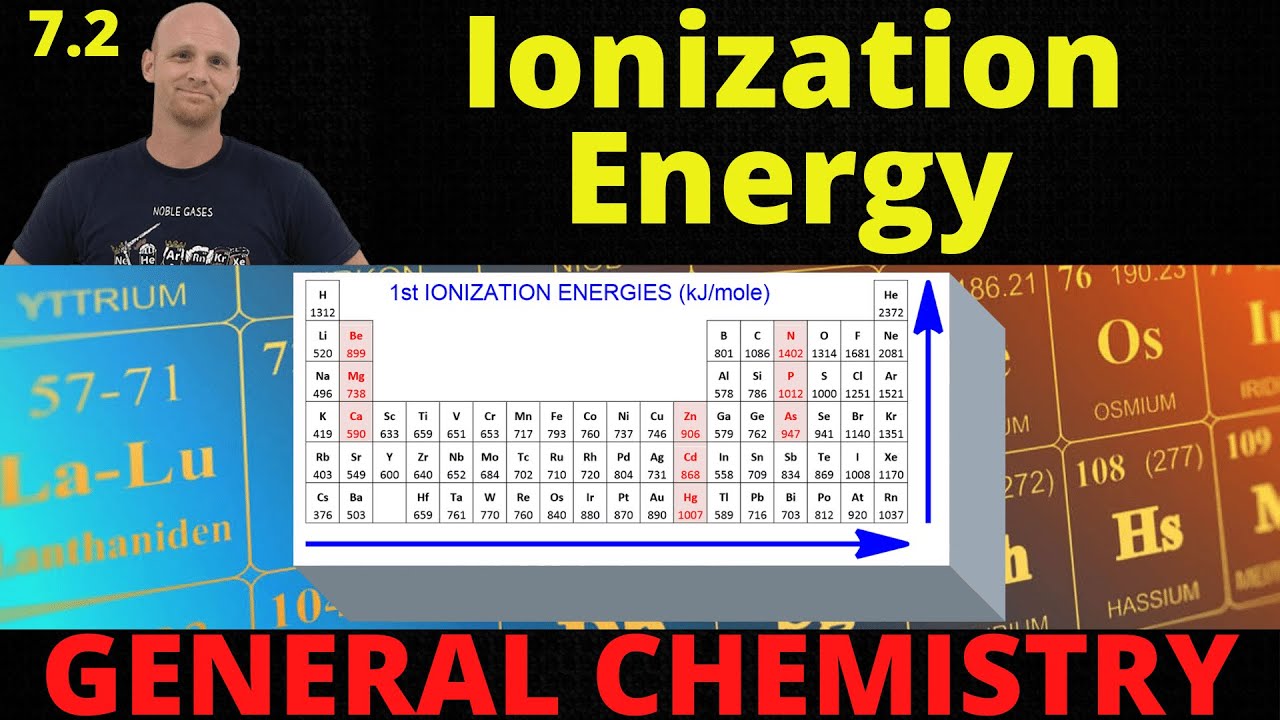
Moving across Period 2 from lithium to neon, first ionization energy generally rises: Li < Be < B < C < N < O < F < Ne. Neon, with a completely filled valence shell and a high nuclear charge, has by far the largest first ionization energy in the period.
3 Key Exceptions to the Ionization Energy Trend
There are important reversals of the left-to-right ionization energy trend within a period, and you must know all of them. Graphing the first ionization energies across Period 2 reveals dips at two specific points: boron is lower than beryllium, and oxygen is lower than nitrogen. A third exception involves filled d subshells.

Exception 1: Beryllium > Boron (Filled s Subshell)
Beryllium's electron configuration ends in 2s² — a completely filled s subshell. Filled subshells carry extra stability. Because beryllium's electrons are already in a particularly stable arrangement, it actually costs more energy to remove one of them than expected, pushing beryllium's ionization energy above boron's.
Pattern: This filled-s-subshell exception extends down the periodic table. Just as Be > B, so too: Mg > Al, and Ca > Ga.
Exception 2: Nitrogen > Oxygen (Half-Filled p Subshell)
Nitrogen's electron configuration ends in 2p³ — a half-filled p subshell. By Hund's rule, each of the three 2p orbitals holds one electron with parallel spins, and this alignment lowers the total energy of the subshell. Removing one electron disrupts this favorable arrangement, requiring extra energy. Nitrogen therefore has a higher first ionization energy than oxygen, despite being to the left of it in the period.
Pattern: The half-filled-p-subshell exception also extends down: N > O, P > S, and As > Se.
Exception 3: Zinc, Cadmium, Mercury (Filled d Subshell)
A filled d subshell also confers extra stability. As a result, these pairs are known reversals of the general ionization energy trend:
- Zn > Ga
- Cd > In
- Hg > Tl
The general trend predicts ionization energy should increase from left to right, but all three pairs above represent known exceptions — traceable to the extra stability of a filled d subshell. Note that this exception is only covered in some general chemistry courses.
Summary: All 3 Ionization Energy Exceptions
Filled s subshell (IE higher than expected): Be, Mg, Ca
Half-filled p subshell (IE higher than expected): N, P, As
Filled d subshell (IE higher than expected): Zn, Cd, Hg
Practice Problems: General Trend vs. Exceptions
Exam questions on ionization energy fall into 2 categories: testing the general periodic trend, or testing the exceptions. Both are fair game, and it helps to work through examples of each.
General Trend Question
Example: Which has the highest first ionization energy — Li, Be, B, or C?
Moving left to right, the general trend holds throughout this sequence: Li < Be < B < C. There are no exceptions in this range (the exception is between Be and B, meaning Be is higher, but carbon is still higher than all of them). The answer is C (carbon).
Follow-up: add N to the list — Li, Be, B, C, or N?
Nitrogen sits to the right of carbon. The exception only applies when comparing N to O — not N to C. Nitrogen is the rightmost element here, and the general trend holds, so the answer is N (nitrogen).
Exception Question
Example: Which has the highest first ionization energy — Be, B, C, N, or O?
Oxygen is furthest to the right, but the half-filled p subshell exception means nitrogen beats oxygen. The answer is N (nitrogen). A question structured this way is directly testing whether you know the N > O ionization energy exception.
Common Mistake: Students instinctively pick the rightmost element in the period as having the highest ionization energy. That works most of the time, but not when an exception element is in the list. Always check whether any element in the set is a beryllium-group or nitrogen-group exception before committing to an answer.
What Are Successive Ionization Energies?
The general periodic trend discussed above applies only to the first ionization energy. When an atom loses more than one electron, we describe the energy costs with successive ionization energies: IE₁, IE₂, IE₃, and so on.
Valence vs. Core Electrons
The most important principle governing successive ionization energies is this: valence electrons are far easier to remove than core electrons. Valence electrons occupy the outermost shell and sit at greater distances from the nucleus, experiencing weaker attraction. Core electrons, buried in inner shells, are both closer to the nucleus and more strongly held.
As each successive electron is removed, the remaining ion becomes smaller (fewer electrons means less electron-electron repulsion and a reduced electron cloud). Each shrinkage brings the remaining electrons closer to the nucleus and increases the difficulty of removing the next one. As a result, successive ionization energies always increase as long as you are removing electrons from the same shell.
Boron: Successive Ionization Energies IE₁ Through IE₄
Boron has the electron configuration 1s² 2s² 2p¹. It has three valence electrons (in the second shell) and two core electrons (in the 1s subshell). The successive ionization energies illustrate the valence-to-core jump dramatically:
| Ionization | Reaction | Electron Removed From | IE (kJ/mol) |
|---|---|---|---|
| IE₁ | B(g) → B⁺(g) + e⁻ | Valence (2p) | 801 |
| IE₂ | B⁺(g) → B²⁺(g) + e⁻ | Valence (2s) | 2,427 |
| IE₃ | B²⁺(g) → B³⁺(g) + e⁻ | Valence (2s) | 3,660 |
| ▶ IE₄ | B³⁺(g) → B⁴⁺(g) + e⁻ | Core (1s) ← BIG JUMP | 25,026 |
IE₁ through IE₃ increase steadily as the boron ion shrinks with each successive removal. Then IE₄ skyrockets to 25,026 kJ/mol — nearly seven times IE₃ — because the fourth electron is a core electron in the 1s subshell, held far more tightly by the nucleus.
How to Identify Valence Electrons from the Successive IE Big Jump
The dramatic increase in successive ionization energy that marks the transition from valence to core electron removal is one of the most testable patterns in this topic. The rule is simple:
- All ionization energies before the big jump correspond to valence electrons.
- The first ionization energy at or after the big jump corresponds to a core electron.
Example: Identifying an Unknown Element from Successive Ionization Energy Data
Suppose you are given the following successive ionization energy data:
- IE₁ = 578 kJ/mol
- IE₂ = 1,817 kJ/mol
- IE₃ = 2,745 kJ/mol
- IE₄ = 11,578 kJ/mol ← big jump
The large leap between IE₃ and IE₄ indicates that the first three electrons removed are valence electrons and the fourth is a core electron. The element therefore has three valence electrons. The most common exam answers are boron (B) or aluminum (Al), both in Group 13.
This pattern may also appear in graphical form: a plot of ionization energy versus electron number will show a gradual rise followed by a sudden, steep jump. Wherever that steep jump occurs, you have crossed from valence electrons into core electrons.
Valence electron count by group (quick reference):
- Group 1 (alkali metals): 1 valence electron
- Group 2 (alkaline earths): 2 valence electrons
- Group 13 (boron group): 3 valence electrons
- Group 14 (carbon group): 4 valence electrons
- Group 15 (nitrogen group): 5 valence electrons
- Group 16 (oxygen group): 6 valence electrons
- Group 17 (halogens): 7 valence electrons
- Group 18 (noble gases): 8 valence electrons
How to Find the Highest nth Ionization Energy
A particularly tricky question type asks which element in a set has the highest second (or third, or fourth) ionization energy — not the first. Students who reflexively apply the general trend ("rightmost element wins") will get these wrong.
The key insight: the general periodic trend applies only to IE₁. For any higher ionization energy, you must ask which element hits a core electron first when that specific electron is removed.
Example: Which has the highest second ionization energy — Na, Mg, Al, or Si?
Valence electron counts: Na (1), Mg (2), Al (3), Si (4).
When removing the second electron from each element:
- Na: already used up its only valence electron at IE₁. IE₂ removes a core electron — enormous energy cost.
- Mg, Al, Si: IE₂ still removes a valence electron for all three — far easier.
The answer is Na (sodium). Whenever a question asks for the highest nth ionization energy, look for the element that runs out of valence electrons exactly at that step — meaning it has only (n − 1) valence electrons.
General rule: The element with the highest nth ionization energy is the one with exactly (n − 1) valence electrons. For the highest second IE, look for the element with one valence electron — an alkali metal. For the highest third IE, look for the element with two valence electrons — an alkaline earth metal.
8 Key Takeaways: Ionization Energy
- Ionization energy is the energy required to remove an electron from a gaseous atom to form a gaseous cation. It is always endothermic (positive).
- The general periodic trend is the inverse of atomic radius: ionization energy increases left to right across a period and increases bottom to top within a group.
- Exception 1 — Filled s subshell: Elements with a completely filled s subshell (Be, Mg, Ca) have higher ionization energies than the next element to their right (B, Al, Ga).
- Exception 2 — Half-filled p subshell: Elements with a half-filled p subshell (N, P, As) have higher ionization energies than the next element to their right (O, S, Se).
- Exception 3 — Filled d subshell: Zn, Cd, and Hg have higher ionization energies than Ga, In, and Tl, respectively.
- Successive ionization energies always increase as each electron removal leaves a smaller, more tightly held ion.
- A dramatic jump in successive ionization energy marks the transition from removing valence electrons to removing core electrons. The number of ionization energies before the jump equals the number of valence electrons.
- The general periodic trend applies only to IE₁. For higher ionization energies, identify which element first crosses from valence to core electrons at that step — that element will have the highest nth ionization energy.