
5.1 The First Law of Thermodynamics, Enthalpy, and Phase Changes


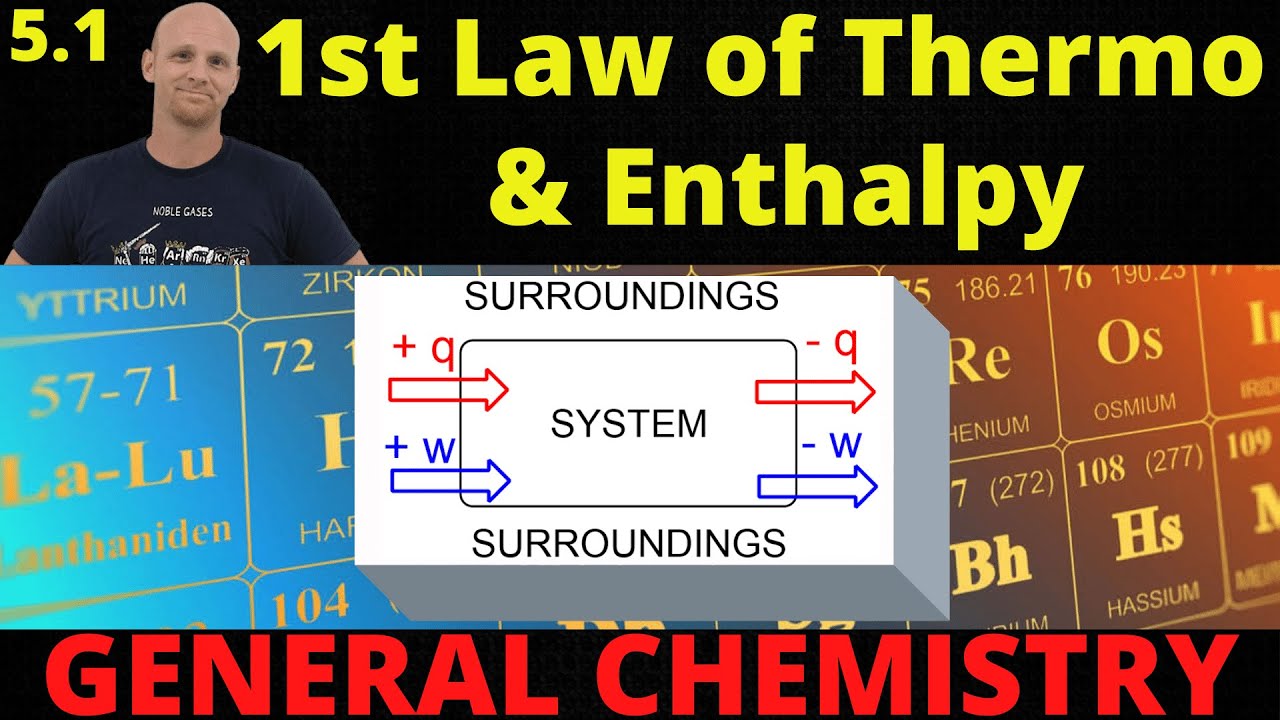

PRE-HEALTH PREP


First Law of Thermodynamics
General Chemistry 5.1
Lesson Overview
The first law of thermodynamics states that energy cannot be created or destroyed, expressed mathematically as ΔE = q + w, where q represents heat and w represents work exchanged between a system and its surroundings. Enthalpy (ΔH) equals the heat of a reaction at constant pressure and functions as a state function, with positive ΔH indicating endothermic processes and negative ΔH indicating exothermic processes. Enthalpy values scale proportionally with stoichiometric amounts, and the six phase changes — melting, vaporization, sublimation, condensation, freezing, and deposition — are each classified as endothermic or exothermic based on the direction of heat transfer.
Table of Contents
- Energy and Units
- The First Law of Thermodynamics
- System and Surroundings
- 4 Sign Conventions for q and w
- Worked Example: Calculating ΔE
- 3 Effects of Internal Energy on Gas Temperature
- PV Work
- Enthalpy at Constant Pressure
- Enthalpy as a State Function
- Endothermic vs. Exothermic Reactions
- Enthalpy Stoichiometry
- 6 Phase Changes and Their Enthalpy
- Key Takeaways
Energy and Units in Thermochemistry
Before diving into the first law of thermodynamics, it helps to get clear on what energy actually is — and fair warning, a precise definition is harder than it sounds. Even seasoned chemists can struggle to articulate it. For our purposes, energy is simply defined as the ability to do work. That definition will carry us far through general chemistry.
The SI unit of energy is the joule (J). One joule equals one kilogram·meter² per second², or equivalently one newton·meter. In chemistry you will encounter energy measured in joules most frequently, though calories also appear. A calorie was historically defined as the quantity of heat required to raise the temperature of one gram of water by one degree Celsius. One calorie equals exactly 4.184 joules.
Capital-C vs. lowercase-c Calorie: The nutritional Calorie (capital C) printed on food labels is actually a kilocalorie — one thousand lowercase calories. A Snickers bar listed at 180 Calories therefore contains 180,000 cal of chemical energy. Keep that distinction in mind whenever unit conversions appear on an exam.
Throughout thermochemistry, energy values are reported in joules (J) or kilojoules (kJ), with calories appearing occasionally. The nutritional Calorie (kcal) can surface in applied problems, so knowing all three units and how to interconvert them is essential for general chemistry success.
| ENERGY — Quick Reference |
|---|
| Energy — the ability to do work (SI unit is Joules) |
| 4.184 J = 1 cal |
| 1 Cal = 1 kcal = 1000 cal |
The First Law of Thermodynamics: Energy Cannot Be Created or Destroyed
The first law of thermodynamics states that energy cannot be created or destroyed — it can only be transferred or converted from one form to another. The total energy of the universe is constant. This principle is one of the most fundamental in all of chemistry and physics.
Example: Energy Conservation in Practice
Suppose a room contains 1,000 J of energy. An hour later, a measurement reveals 2,000 J. The correct interpretation is not that 1,000 J was spontaneously created — it is that 1,000 J was transferred into the room from the surroundings. The universe's total energy balance remains unchanged.
Mathematically, the first law of thermodynamics is expressed as:
ΔE = q + w
- ΔE — change in internal energy of the system (a measure of the total energy contained in a sample)
- q — heat transferred between system and surroundings
- w — work done on or by the system
Heat and work are the 2 primary mechanisms by which energy moves between a system and its surroundings. Every thermochemistry calculation ultimately traces back to this equation.
System and Surroundings: The 2 Categories in Thermodynamics
Two terms define every thermodynamic analysis. The system is whatever object or process you are examining — a chemical reaction, a gas sample, a beaker of solution. Everything outside the system, extending to the rest of the universe, is called the surroundings. Those are the only two categories that exist: system and surroundings.
Energy exchange between a system and its surroundings occurs through exactly 2 channels: heat (q) and work (w). Understanding which direction energy flows — and keeping track of the signs — is the core skill in first law problems.

4 Sign Conventions for q and w
The sign conventions for q and w are defined entirely from the perspective of the system. When the system gains energy, the quantity is positive; when the system loses energy, it is negative. These 4 cases cover every situation you will encounter:
| Quantity | Direction | Sign | Effect on System |
|---|---|---|---|
| q | Heat flows into system | Positive (+) | System gains energy |
| q | Heat flows out of system | Negative (−) | System loses energy |
| w | Work done on system by surroundings | Positive (+) | System gains energy |
| w | Work done by system on surroundings | Negative (−) | System loses energy |
Intuition for the work sign: Think of it this way — if you spend an afternoon swinging an axe and splitting wood, do you end the day with more or less energy? Far less. The entity doing the work is the entity losing energy. When the surroundings do work on the system, the surroundings lose energy and the system gains it (w > 0). When the system does work on the surroundings, the system is the one expending energy (w < 0).
Both signs are always referenced to the system — never to the surroundings. Keep that perspective locked in, because sign errors on thermochemistry problems almost always trace back to forgetting this rule.
Worked Example: Calculating ΔE
Example: Applying ΔE = q + w
Suppose 30 J of heat is transferred from the system to the surroundings, and the surroundings do 10 J of work on the system. What is ΔE?
Step 1 — Assign signs:
Heat leaves the system → q = −30 J
Work done on the system → w = +10 J
Step 2 — Apply the first law equation:
ΔE = q + w = (−30 J) + (+10 J) = −20 J
The system lost a net 20 J of internal energy.
These problems are straightforward once you correctly interpret the sign of each term. The calculation itself is simple addition; the challenge is the translation from verbal description to signed quantity. Mastering sign conventions is the single most important skill for first law of thermodynamics exam questions.
3 Effects of Internal Energy on Gas Temperature
For a sample of gas, temperature is a direct reflection of internal energy. This relationship has 3 important consequences you must know for general chemistry:
- If ΔE > 0 (system gains energy), the temperature of the gas increases.
- If ΔE < 0 (system loses energy), the temperature of the gas decreases.
- If ΔE = 0 (no net energy change), the temperature is constant — this is called an isothermal process.
The critical insight is that temperature change depends on the net ΔE, not on q or w individually. A gas could simultaneously absorb heat and perform work such that the two effects cancel, leaving the temperature unchanged. Judging temperature change requires evaluating ΔE as a whole.
PV Work: Pressure-Volume Work for Gases
For gases, the most common form of work in thermochemistry is pressure-volume (PV) work — the work done when a gas expands or is compressed against an external pressure. The expression is:
w = −PextΔV
The sign consequences follow directly from this equation:
- Expanding gas: ΔV > 0, so w = −PΔV is negative. The gas is pushing back the surroundings — the system is doing work and losing energy.
- Compressed gas: ΔV < 0, so w = −PΔV is positive. The surroundings are compressing the gas — the system is gaining energy.
Example: Determining the Sign of ΔE for a Gas
Suppose heat is transferred from the gas (system) to the surroundings, and simultaneously the gas is expanding. What can you conclude about ΔE?
Heat leaving the system → q < 0
Gas expanding → w < 0
Both terms are negative, so ΔE = q + w must also be negative. The temperature of the gas decreases.
Note: if q and w had opposite signs, you could not determine the sign of ΔE without knowing the magnitudes. When both share the same sign, however, the sign of ΔE is unambiguous.
What Is Enthalpy? (ΔH Explained)
Enthalpy at Constant Pressure
Enthalpy (H) is a thermodynamic property that is closely related to heat. Specifically, the change in enthalpy (ΔH) equals the heat of a reaction when the reaction is carried out at constant pressure:
ΔH = qp
The subscript "p" denotes constant pressure. This condition is extremely common in chemistry: reactions performed in open flasks, beakers, or test tubes are all exposed to the atmosphere, which maintains an essentially constant pressure of roughly one atmosphere.
Example: Constant vs. Non-Constant Pressure
Constant pressure: A reaction in an open beaker begins and ends at atmospheric pressure. ΔH = qp exactly.
Non-constant pressure: Zinc metal and hydrochloric acid are mixed in a sealed two-liter bottle. As hydrogen gas is produced, the internal pressure rises. If left unchecked, the pressure increase could be dramatic. In this sealed system, ΔH and q are still related — but they are not exactly equal, because the changing pressure means the system is doing (or receiving) additional PV work not accounted for by a simple heat measurement.
Enthalpy as a State Function: Why the Path Doesn't Matter
Enthalpy is an example of a state function — a quantity whose value depends only on the current state of the system (its initial and final conditions), not on the path taken to get there.
Analogy: Altitude Change
Two hikers both start at sea level and end up at the summit of the same mountain. One drives to the trailhead and hikes up; the other flies to the area and parachutes down from a higher altitude. Despite taking completely different routes, both experience the same change in altitude. Altitude change is path-independent — it is a state function. Enthalpy works the same way: only the starting state and ending state matter.
Many quantities in thermochemistry are state functions: ΔE, ΔH, temperature, entropy (ΔS), and free energy (ΔG). However, heat (q) and work (w) are not state functions — they depend on the specific path taken between two states.
Example: Why q and w Are Path-Dependent
A system starts with 100 J of internal energy and ends with 140 J. Therefore ΔE = 40 J — determined entirely by the initial and final states.
But is that 40 J entirely due to heat? Entirely due to work? Some combination of both? Any split that satisfies q + w = 40 J is mathematically valid. Without knowing the specific process that was carried out, you cannot determine q or w individually. That is precisely what it means for a quantity to not be a state function.
Common Exam Question: "Which of the following is not a state function?" The answer is almost always q (heat) or w (work). ΔE and ΔH are both state functions. When in doubt, remember: if a quantity depends on how you got there (the path), it is not a state function.
Endothermic vs. Exothermic Reactions: How to Use the Sign of ΔH
The sign of ΔH tells you whether a reaction absorbs or releases heat at constant pressure. This distinction between endothermic and exothermic reactions is one of the most tested concepts in general chemistry thermochemistry.
| Term | Sign of ΔH | Heat Direction | Effect on Surroundings |
|---|---|---|---|
| Endothermic | ΔH > 0 (positive) | System absorbs heat from surroundings | Surroundings get colder |
| Exothermic | ΔH < 0 (negative) | System releases heat to surroundings | Surroundings get hotter |
The prefixes are your memory aids: endo means "inside" — heat enters the system. Exo means "outside" — heat exits the system into the surroundings.
Example: Reading a Thermometer in a Reaction Beaker
A chemical reaction occurs dissolved in water inside a beaker. A thermometer placed in the water measures the surroundings, not the reaction itself. If the temperature reading rises, the reaction is releasing heat to the water — the reaction is exothermic (ΔH < 0). If the temperature falls, the reaction is drawing heat away from the water — the reaction is endothermic (ΔH > 0).
Enthalpy Stoichiometry: Scaling ΔH with Moles
The ΔH reported for a reaction corresponds to the exact molar amounts shown in the balanced equation. Scaling the reaction scales ΔH proportionally. This is one of the most common calculation types in thermochemistry.
Reference Reaction:
2 H₂(g) + O₂(g) → 2 H₂O(l) ΔH = −572 kJ
This ΔH applies to exactly 2 mol H₂ reacting with 1 mol O₂ to yield 2 mol H₂O.
Example 1: Scaling by Moles of a Reactant
Question: What is ΔH when 3 mol of O₂ is consumed?
The balanced equation shows 1 mol O₂. Consuming 3 mol O₂ means the reaction runs three times over.
3 mol O₂ × (−572 kJ / 1 mol O₂) = −1,716 kJ
Example 2: Starting with Grams of a Product
Question: What is ΔH when 9 g of H₂O is produced?
Step 1 — Convert grams to moles:
Molar mass of H₂O = 2(1) + 16 = 18 g/mol
9 g × (1 mol / 18 g) = 0.5 mol H₂O
Step 2 — Apply the stoichiometric ratio:
0.5 mol H₂O × (−572 kJ / 2 mol H₂O) = −143 kJ
Half a mole of water is one-quarter of the two moles in the balanced equation, so the answer is one-quarter of 572 kJ — which confirms −143 kJ.
6 Phase Changes and Their Enthalpy
Every phase change involves a transfer of heat — and therefore a ΔH. There are 6 phase changes in total, organized as 3 endothermic transitions (moving to higher-energy states) and 3 exothermic transitions (moving to lower-energy states).
The 3 Endothermic Phase Changes (ΔH > 0)
All transitions toward higher-energy phases (solid → liquid → gas) require the input of heat from the surroundings.
| Transition | Common Name | Chemistry Term | Enthalpy Label |
|---|---|---|---|
| Solid → Liquid | Melting | Fusion | ΔHfus |
| Liquid → Gas | Boiling / Evaporation | Vaporization | ΔHvap |
| Solid → Gas | Sublimation | Sublimation | ΔHsub |
On the word "fusion": In everyday language, "fusion" suggests combining things together — not melting them apart. In thermochemistry, however, fusion means melting (solid → liquid). The nomenclature is historical and admittedly counterintuitive, but it is standard and must be memorized.
Sublimation: Dry Ice
Solid carbon dioxide (CO₂) sublimes directly from solid to gas at atmospheric pressure — it never passes through a liquid phase. Because the material skips the liquid phase entirely, it never "gets wet." This is the origin of the name dry ice.
The 3 Exothermic Phase Changes (ΔH < 0)
The reverse transitions — from higher-energy to lower-energy phases — all release heat to the surroundings.
| Transition | Common Name | Chemistry Term |
|---|---|---|
| Gas → Liquid | Condensation | Condensation |
| Liquid → Solid | Freezing | Freezing / Crystallization |
| Gas → Solid | Deposition | Deposition / Vapor Deposition |
Common Misconception — Freezing Releases Heat: Students often find it strange that freezing is exothermic. "But my freezer is cold!" Yes — but your freezer is part of the surroundings. Its job is to continuously pump heat out of the compartment. The water inside releases heat as it freezes; the freezer removes that heat to maintain a low temperature. Melting requires added heat, so the reverse process — freezing — must release heat. The logic is symmetric.
Example: Why Steam Burns Are Worse Than Hot Water Burns
Steam at 100 °C and liquid water at 100 °C are at the same temperature — yet a steam burn is typically far more severe. When steam contacts your skin, it immediately condenses (gas → liquid). Condensation is exothermic, so in addition to the heat already stored in the steam at 100 °C, your skin absorbs the substantial enthalpy of vaporization released during condensation. That extra energy release is why steam inflicts deeper burns than liquid water at the same temperature.
Deposition in Technology: Deposition (gas → solid) is used extensively in semiconductor manufacturing. To coat a microchip with a thin layer of gold, the chip is placed in a sealed chamber filled with gold vapor. Under controlled temperature and pressure conditions, the gold vapor deposits as a uniform solid film directly onto the chip surface — bypassing the liquid phase entirely.

Key Takeaways
- The First Law of Thermodynamics states that energy cannot be created or destroyed: ΔE = q + w, where q is heat and w is work.
- Signs for q and w are always defined relative to the system: positive when the system gains energy, negative when the system loses energy.
- For a gas, temperature reflects internal energy: ΔE > 0 raises temperature, ΔE < 0 lowers it, and ΔE = 0 is an isothermal process.
- PV work for a gas is w = −PΔV: expansion (positive ΔV) gives negative w; compression (negative ΔV) gives positive w.
- Enthalpy (ΔH) equals heat (q) at constant pressure, which applies to most open-vessel reactions run at atmospheric conditions.
- Enthalpy is a state function (path-independent); heat (q) and work (w) are not state functions — they depend on the path.
- Endothermic reactions (ΔH > 0) absorb heat from the surroundings, cooling them. Exothermic reactions (ΔH < 0) release heat, warming the surroundings.
- Enthalpy scales with stoichiometry: doubling the moles in a reaction doubles ΔH. Use dimensional analysis to convert between grams, moles, and kJ.
- There are 6 phase changes: melting (fusion), vaporization, and sublimation are endothermic; freezing (crystallization), condensation, and deposition are exothermic.
- Freezing and condensation release heat — this seems counterintuitive but follows directly from energy conservation. Deposition is the gas-to-solid transition and is also exothermic.