
18.5 Gibbs Free Energy and the Equilibrium Constant



PRE-HEALTH PREP


Gibbs Free Energy and the Equilibrium Constant
General Chemistry 18.5
Lesson Overview
The relationship between Gibbs free energy and the equilibrium constant connects thermodynamic spontaneity to the position of chemical equilibrium through the equations ΔG = ΔG° + RT ln Q and ΔG° = −RT ln K. A negative ΔG° corresponds to an equilibrium constant greater than one, indicating that products are favored, while a positive ΔG° yields K less than one, favoring reactants. The reaction quotient Q determines spontaneity under non-standard conditions: when Q < K the forward reaction proceeds spontaneously, and at equilibrium ΔG equals zero.
Standard vs. Non-Standard Conditions for Gibbs Free Energy
In general chemistry, you can calculate ΔG° (the standard Gibbs free energy change) using free energies of formation—products minus reactants. That calculation works perfectly under standard conditions, but here's the catch: most of the time, you are not operating under standard conditions when carrying out a chemical reaction.
Consider what happens when you walk into the lab to synthesize a product. You mix reactants together and hope to form the desired product. At the start, you have only reactants and no products—and that is decidedly not standard conditions.
What Are Standard Conditions?
The degree symbol (°) on ΔG° denotes standard conditions, which require that all reactants and all products are present at a concentration of 1. For aqueous species, that means 1 M concentrations; for gaseous species, 1 atm partial pressures. Every species must be present and equal in concentration at a value of one.
Since you rarely begin a reaction with all reactants and products at exactly 1 M or 1 atm, ΔG° alone does not tell you whether the reaction will proceed spontaneously under your actual conditions. For that, you need the non-standard ΔG—the plain ΔG without the degree symbol.
The Non-Standard ΔG Equation: ΔG = ΔG° + RT ln Q
To calculate the Gibbs free energy change under non-standard conditions, use the following equation:
You start with the standard value (ΔG°), then add a correction term that accounts for how far your actual concentrations deviate from standard conditions. The correction term contains the reaction quotient Q, which equals products over reactants, each raised to the power of its stoichiometric coefficient. Unlike the equilibrium constant K, the concentrations in Q are measured at whatever point the reaction happens to be—they do not have to be equilibrium values.
Why the Equation Works: A Sanity Check
If you are under standard conditions, all concentrations equal 1, so Q = 1. Since ln(1) = 0, the entire correction term vanishes, and ΔG simply equals ΔG°—exactly what you would expect.
If you are not under standard conditions, Q takes on some other value, and the correction term shifts ΔG higher or lower than ΔG° depending on your actual conditions.
Example: Calculating ΔG Under Non-Standard Conditions
Setting Up the Problem
Consider the reaction:
Given that ΔG° = −33.3 kJ at 298 K, calculate the non-standard Gibbs free energy change ΔG when the partial pressures are: PN2 = 0.1 atm, PH2 = 0.1 atm, and PNH3 = 100 atm.
The first thing to notice: these partial pressures are clearly not all equal to 1, so you are not under standard conditions. That means you need the full equation ΔG = ΔG° + RT ln Q.
Calculating the Reaction Quotient Q
The reaction quotient for this system is:
Substituting the given pressures:
Unit Conversion and Final Calculation
Now plug into the equation. The gas constant R can be expressed as 8.314 J/(mol·K), but since ΔG° is given in kilojoules, the units must match. Convert R to kilojoules:
Common Mistake: Mismatched Units
If ΔG° is in kilojoules and R is in joules (or vice versa), your answer will be off by a factor of 1,000. Always ensure both quantities use the same energy unit before adding them.
Substituting all values:
Interpreting the Result
What Does a Positive ΔG Mean?
Under these specific conditions, ΔG is positive, so the forward reaction is not spontaneous. The reverse reaction—decomposition of NH3 back into N2 and H2—is what actually favors proceeding.
Notice, however, that ΔG° is negative, meaning the forward reaction would be spontaneous under standard conditions. This example powerfully illustrates why non-standard ΔG matters: the sign of spontaneity can flip depending on actual conditions.
Practice Problem: Different Pressure Conditions
Using the same equation ΔG = ΔG° + RT ln Q, calculate ΔG for the following reaction at 298 K when PN2 = 0.1 atm, PH2 = 0.1 atm, and PNH3 = 10.0 atm.
N2(g) + 3H2(g) → 2NH3(g) ΔG° = −33.3 kJ
Note how changing PNH3 from 100 atm to 10.0 atm changes Q and therefore shifts ΔG. Apply the same Q formula: Q = (PNH3)2 / [(PN2)(PH2)3], then plug in to find the non-standard ΔG under these adjusted conditions.
3 Key Relationships Between ΔG, Q, and Equilibrium
When Does ΔG Equal Zero?
As a reaction proceeds, the non-standard ΔG changes continuously. When ΔG finally reaches zero, the reaction has arrived at chemical equilibrium. It is not ΔG° that equals zero at equilibrium—ΔG° is a fixed value determined by looking up free energies of formation. It is the plain, non-standard ΔG that evolves as the reaction progresses and ultimately reaches zero at equilibrium.
Exam Favorite
"Which of the following is true about a reaction at equilibrium?" The correct answer is ΔG = 0. The statement ΔG° = 0 could be true for a rare reaction, but it is not a general requirement for equilibrium.
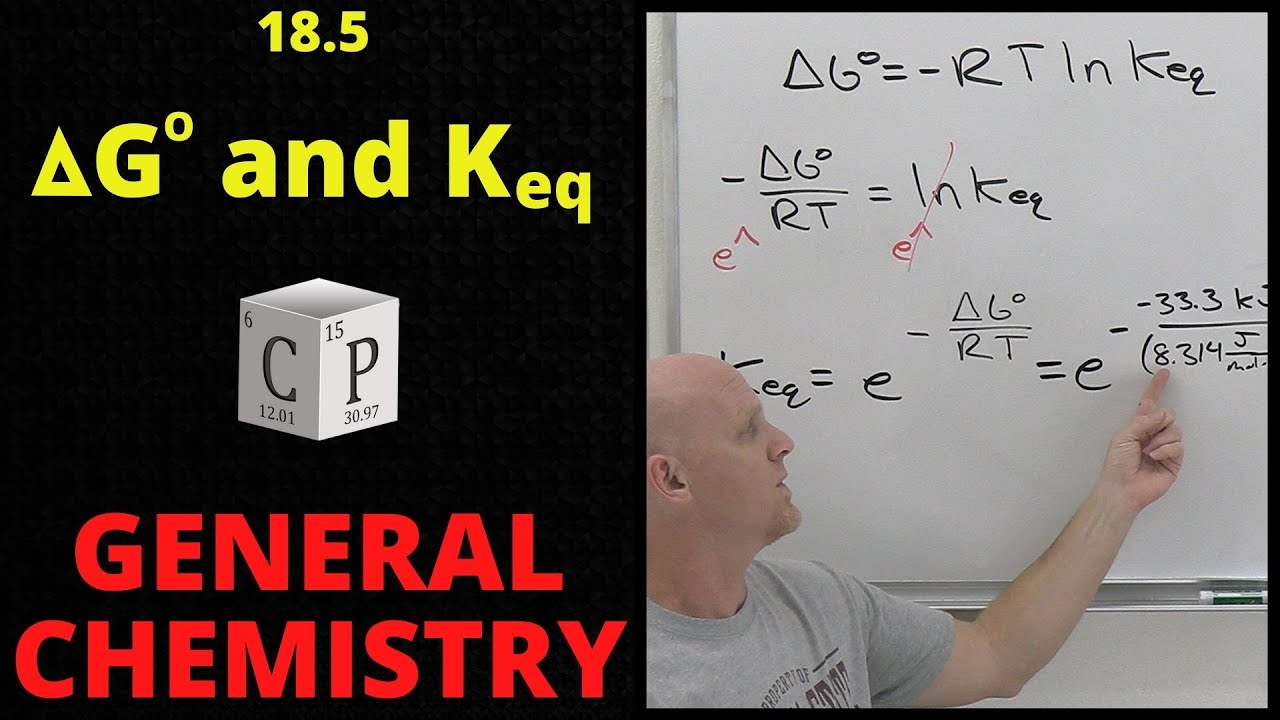
Deriving ΔG° = −RT ln K
At equilibrium, ΔG = 0 and Q = K. Substituting into the master equation:
Rearranging yields one of thermodynamics' most important relationships:
This equation directly links the standard Gibbs free energy change to the equilibrium constant. At a given temperature, knowing either quantity lets you calculate the other.
Q vs. K and the Sign of ΔG
The relationship between the reaction quotient Q and the equilibrium constant K determines whether a reaction proceeds forward, backward, or stands at equilibrium:
| Condition | Direction | ΔG | Le Chatelier Interpretation |
|---|---|---|---|
| Q < K | Forward (toward products) | Negative (spontaneous) | Too few products; reaction shifts right |
| Q = K | Equilibrium | Zero | System balanced; no net shift |
| Q > K | Reverse (toward reactants) | Positive (non-spontaneous forward) | Too many products; reaction shifts left |
These 3 relationships are fully consistent with Le Chatelier's principle: when Q < K, the system needs more products to reach equilibrium, so the forward reaction is spontaneous. When Q > K, the system has excess products, and the reverse reaction brings it back toward equilibrium.
How ΔG° Predicts the Equilibrium Constant K
The sign of ΔG° tells you whether products or reactants are favored at equilibrium. This is one of the most tested relationships in general chemistry thermodynamics:
| ΔG° | K | Equilibrium Favors | Reasoning |
|---|---|---|---|
| Negative | > 1 | Products | Forward reaction is spontaneous from standard conditions; products accumulate until equilibrium is reached |
| Positive | < 1 | Reactants | Reverse reaction is spontaneous from standard conditions; reactants accumulate at equilibrium |
| ≈ Zero | ≈ 1 | Neither strongly | Products and reactants are roughly equal at equilibrium (rare) |
Thinking It Through
If ΔG° is negative, the forward reaction is spontaneous starting from standard conditions (where all concentrations are 1). As the reaction proceeds, reactants convert into products, causing product concentrations to rise above 1 and reactant concentrations to drop below 1. At equilibrium, you end up with more products than reactants—meaning K > 1.
The reverse logic applies when ΔG° is positive: the reaction favors making more reactants, so K < 1.
Remember
Equilibrium constants do not have to equal 1. Most reactions have K values that are significantly larger or smaller than 1. The case K = 1 only arises when ΔG° happens to be very close to zero.
Example: Calculating the Equilibrium Constant K from ΔG°
Rearranging the Equation
Starting from ΔG° = −RT ln K, solve for the equilibrium constant K:
Raising both sides as a power of e eliminates the natural logarithm, since e and ln are inverse functions.
Plugging In Values
Calculate the equilibrium constant K at 298 K for the same reaction:
Since ΔG° is negative, expect K > 1 before even touching a calculator. On a multiple-choice exam, that knowledge alone can eliminate wrong answers.
Converting ΔG° to joules for unit consistency with R:
Watch the Double Negative
The most common error on this calculation is forgetting that a negative times a negative yields a positive. The negative sign in front of ΔG° and the negative value of ΔG° itself combine to produce a positive exponent.
As expected, K is much greater than 1, confirming that this reaction strongly favors products at 298 K. A ΔG° of −33.3 kJ corresponds to an equilibrium constant of approximately 687,000.
Graphical Interpretation: Free Energy vs. Reaction Progress
Shape of the Free Energy Curve
Imagine plotting Gibbs free energy on the y-axis against reaction progress on the x-axis, moving from pure reactant A on the left to pure product B on the right. For a reaction where ΔG° is negative, pure A sits higher in energy than pure B.
You might expect a straight line connecting the two endpoints, but the actual curve dips below that line. Why? At any intermediate point, you have a mixture of A and B, and mixtures possess additional entropy due to the greater number of possible microstates. This extra entropy lowers the Gibbs free energy below what a simple interpolation would predict.
The ΔG of Mixing
The vertical distance between the straight line and the actual curve at any point represents the ΔG of mixing. At the two endpoints (pure A or pure B), there is no mixture, so the curve touches the straight line. Everywhere in between, the mixture lowers the free energy.
Mathematically, mixing increases entropy (ΔSmix > 0), and since ΔG = ΔH − TΔS, a positive ΔSmix makes −TΔS negative, pulling ΔG downward.
Locating Equilibrium on the Graph
The free energy curve reaches a minimum—and that minimum is where chemical equilibrium lies. Every Q vs. K relationship plays out on this graph:
- Left of the minimum (Q < K): ΔG is negative, so the forward reaction is spontaneous. The system moves right toward equilibrium.
- Right of the minimum (Q > K): ΔG for the forward reaction is positive, so the reverse reaction is spontaneous. The system moves left toward equilibrium.
- At the minimum (Q = K): ΔG = 0. The system is at equilibrium.
When ΔG° is negative, the energy minimum sits closer to the product side (since K > 1). When ΔG° is positive, the minimum shifts toward the reactant side (since K < 1).
Reading ΔG° from the Graph
The difference in free energy between pure products and pure reactants—the two endpoints—gives you ΔG°. If the product endpoint is lower, ΔG° is negative; if higher, ΔG° is positive.
Graph Summary
This single graph encapsulates every relationship covered in this lesson: ΔG° appears as the endpoint difference, the energy minimum marks equilibrium (Q = K, ΔG = 0), and the position of that minimum reflects whether the equilibrium constant K is greater or less than 1. If you can read this graph, you understand the interplay among ΔG, ΔG°, Q, and K.
8 Key Takeaways: Gibbs Free Energy and Equilibrium
- ΔG° applies only under standard conditions (all concentrations at 1 M or 1 atm). Most real reactions operate under non-standard conditions, requiring the full equation ΔG = ΔG° + RT ln Q.
- The reaction quotient Q measures actual concentrations (products over reactants, raised to their coefficients) and serves as the bridge between standard and non-standard free energy values.
- At equilibrium, ΔG = 0 (not ΔG° = 0), and Q equals K. This is the central condition that defines chemical equilibrium from a thermodynamic perspective.
- ΔG° = −RT ln K directly connects the standard Gibbs free energy change to the equilibrium constant, allowing you to calculate either one from the other at a given temperature.
- When ΔG° < 0, K > 1 (products favored at equilibrium). When ΔG° > 0, K < 1 (reactants favored at equilibrium).
- Q vs. K determines spontaneity: Q < K means forward is spontaneous (ΔG < 0); Q > K means reverse is spontaneous (ΔG > 0).
- On a free energy vs. reaction progress graph, the energy minimum marks equilibrium, the endpoint difference gives ΔG°, and the curve dips below a straight line due to the entropy of mixing.
- Always match your units—ΔG° and R must both be in joules or both in kilojoules before performing calculations.