
6.5 Electronic Configurations



PRE-HEALTH PREP


Electron Configuration Explained
Aufbau Principle, Hund's Rule & Pauli Exclusion
General Chemistry 6.5
Electron configuration describes how electrons distribute among an atom's orbitals, governed by 3 fundamental rules: the Aufbau principle, the Pauli exclusion principle, and Hund's rule. The orbital filling order follows a specific sequence determined by subshell energies in multi-electron atoms, with the periodic table's block structure providing a practical map and noble gas notation offering shorthand for heavier elements. Additional topics include the 5 commonly tested exceptions to standard filling (copper, silver, gold, chromium, and molybdenum), electron configurations of ions with emphasis on transition metal cations, and the distinction between ground state and excited state configurations.
3 Rules for Filling Electrons in an Atom
Electron configuration describes how electrons are distributed among the orbitals of an atom. To determine this arrangement, you need 3 fundamental rules: the Aufbau principle, the Pauli exclusion principle, and Hund's rule. Together, these rules dictate the ground state electron configuration for any element on the periodic table.
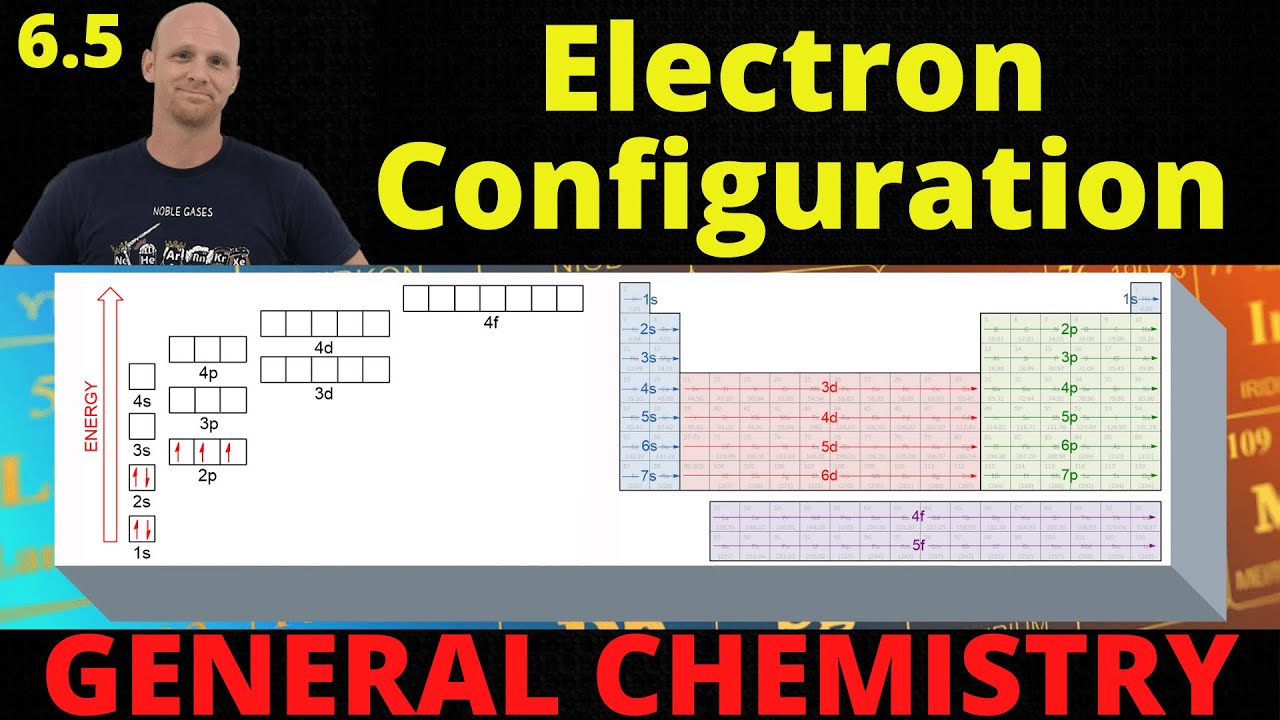
In orbital diagrams, each box represents an orbital, and each orbital can hold at most two electrons. These two electrons must have opposite spins, typically represented by an upward arrow and a downward arrow.
| Rules for Ground State Electron Configurations | |
|---|---|
| Aufbau Principle | Electrons fill orbitals in order of increasing energy. |
| Hund's Rule | Degenerate orbitals each get an electron before pairing. |
| Pauli Exclusion Principle | No 2 electrons in an atom have the same 4 quantum numbers. |

The Aufbau Principle: Lowest Energy Orbitals Fill First
The Aufbau principle states that electrons fill the lowest energy orbitals first, then progressively occupy higher energy levels. In an orbital diagram where subshells are arranged in order of increasing energy, the lowest energy orbital is the 1s, so the very first electron in any atom goes there.
It does not matter whether you represent the first electron as spin-up or spin-down — either convention is perfectly acceptable. However, once you assign a spin direction to the first electron, the second electron in the same orbital must have the opposite spin.
The Pauli Exclusion Principle: No 2 Electrons Share the Same 4 Quantum Numbers
The Pauli exclusion principle states that no two electrons in an atom can share the same set of four quantum numbers. In practical terms, this means two electrons in the same orbital must have opposite spins. Placing two electrons with identical spins in one orbital — both spin-up, or both spin-down — violates this principle.
Common Exam Question: You may be shown several orbital diagrams and asked to identify which one violates the Pauli exclusion principle. Look for any orbital containing two electrons with the same spin direction.
Example: Spotting Violations
If an electron skips the 1s orbital and lands in the 3s while the 1s and 2s are still available, that violates the Aufbau principle — electrons must fill from lowest to highest energy. If two electrons in the same orbital share the same spin, that violates the Pauli exclusion principle.
Hund's Rule: 1 Electron Per Degenerate Orbital Before Pairing
Hund's rule governs how electrons fill degenerate orbitals — orbitals that share the same energy level. Within a set of degenerate orbitals (such as the three 2p orbitals), every orbital receives one electron before any orbital gets a second. Furthermore, all unpaired electrons must have the same spin.
Why does this matter? Placing two electrons in the same orbital when an empty degenerate orbital is available costs pairing energy. Those two electrons repel each other, making that arrangement higher in energy than spreading electrons across separate orbitals. When their spins are aligned, the arrangement is actually lower in energy — and that is part of what Hund's rule captures.
Tip: The order in which you fill degenerate orbitals (left to right, right to left, or starting in the middle) is arbitrary. What matters is that each degenerate orbital gets one electron before any pairing occurs, and all unpaired electrons share the same spin.
Energy Splitting in Multi-Electron Atoms
In hydrogen, which has only a single electron, all orbitals within the same shell are equal in energy. The 2s and 2p orbitals are degenerate, as are the 3s, 3p, and 3d orbitals. However, this changes dramatically once you introduce additional electrons.
In multi-electron atoms, electron-electron repulsion causes the subshells within a given shell to split into different energy levels. Within any shell, the energy ordering follows a consistent pattern: s < p < d < f. For example, in the third shell, 3s is lower in energy than 3p, and 3p is lower than 3d. In the fourth shell, 4s < 4p < 4d < 4f.
Key Distinction: Degenerate means “equal in energy.” Orbitals within the same subshell (such as the three 2p orbitals) are always degenerate. Orbitals in different subshells of the same shell (such as 3s vs. 3p) are degenerate only in one-electron systems like hydrogen.
This energy splitting has profound implications for the order in which electrons fill orbitals, especially once you reach the transition metals where the 3d and 4s subshells are very close in energy.
Orbital Filling Order and the Periodic Table
After the 3p subshell, the electron configuration filling order becomes less intuitive. The 4s subshell is slightly lower in energy than the 3d when both are empty, so electrons fill the 4s before the 3d. The complete filling order is:
1s → 2s → 2p → 3s → 3p → 4s → 3d → 4p → 5s → 4d → 5p → 6s → 4f → 5d → 6p → 7s → 5f → 6d → 7p
The Diagonal Arrow Diagram
One way to remember this filling order is the diagonal arrow diagram. Write out the orbitals by shell — 1s on the first row, 2s and 2p on the second, 3s, 3p, and 3d on the third, and so on. Then draw diagonal arrows from upper-right to lower-left. Following these arrows gives you the correct filling sequence every time.
Pro Tip: While the diagonal arrow diagram works reliably, the periodic table itself is arguably the best tool for determining electron configuration filling order — and you will almost certainly have one available during exams.
The 4 Blocks of the Periodic Table and Orbital Filling
The periodic table is organized into 4 blocks that correspond directly to the type of orbital being filled:
| Block | Orbitals | Max Electrons | Columns | Location on Table |
|---|---|---|---|---|
| s block | 1 orbital | 2 | 2 | First two columns (Groups 1–2) |
| p block | 3 orbitals | 6 | 6 | Right side (Groups 13–18) |
| d block | 5 orbitals | 10 | 10 | Middle (transition metals) |
| f block | 7 orbitals | 14 | 14 | Bottom (lanthanides & actinides) |
As you move across the periodic table, each element adds one more electron. Hydrogen and helium fill the 1s orbital. Lithium and beryllium fill the 2s. Boron through neon fill the 2p. This pattern continues row by row.
Important: The d block elements are always one row behind where you might expect. The transition metals between the 4s and 4p elements are filling the 3d orbitals, not the 4d. Similarly, the f block elements are two rows behind — the lanthanides fill the 4f, not the 6f.
How to Write Standard Electron Configurations
To write an electron configuration, follow the periodic table in atomic number order, noting the subshell and the number of electrons in it at each step.
Example: Hydrogen through Beryllium
Hydrogen (Z = 1): 1s1 — one electron in the 1s orbital.
Helium (Z = 2): 1s2 — two electrons fill the 1s orbital.
Lithium (Z = 3): 1s2 2s1 — the third electron enters the 2s orbital.
Beryllium (Z = 4): 1s2 2s2 — the 2s is now full.
How to Identify Unpaired Electrons
A common exam question asks how many unpaired electrons an atom has. The key insight is that full subshells have no unpaired electrons — every electron is paired. Only partially filled subshells can contain unpaired electrons, and you need to draw out the orbital diagram for those subshells to count them.
Example: Boron
Boron (Z = 5): 1s2 2s2 2p1
The 1s and 2s subshells are full (all paired). The 2p subshell has just one electron — that electron is unpaired. Boron has 1 unpaired electron.
Example: Carbon
Carbon (Z = 6): 1s2 2s2 2p2
A common mistake is to see “2p2” and assume both electrons are paired because the superscript is even. Not so! By Hund's rule, these two electrons occupy separate 2p orbitals with parallel spins. Carbon has 2 unpaired electrons.
Common Mistake: Students often assume that an even number of electrons in a subshell means all are paired. This is only true when the subshell is full. For a partially filled subshell like 2p2, you must apply Hund's rule and draw the orbital diagram.
Reading Periodic Table Group from Configuration Endings
The ending of an electron configuration reveals which column of the periodic table an element belongs to. Carbon ends with 2p2, silicon with 3p2, germanium with 4p2, and tin with 5p2 — all members of Group 14.
| Configuration Ending | Group | Example Elements |
|---|---|---|
| p1 | Boron group (13) | B, Al, Ga, In |
| p2 | Carbon group (14) | C, Si, Ge, Sn |
| p3 | Nitrogen group (15) | N, P, As, Sb |
| p4 | Oxygen group (16) | O, S, Se, Te |
| p5 | Halogens (17) | F, Cl, Br, I |
| p6 | Noble gases (18) | Ne, Ar, Kr, Xe |
Test Strategy: On a multiple-choice exam asking for the ground state electron configuration of sodium, any answer that doesn't end with 3s1 can be immediately eliminated.
What Is Noble Gas Configuration?
Writing out every subshell becomes tedious for heavier elements. The noble gas configuration (also called abbreviated configuration) provides a convenient shorthand. Find the last noble gas that comes before your element on the periodic table, write its symbol in brackets, and then list only the remaining subshells.
Example: Sodium (Z = 11)
Standard electron configuration: 1s2 2s2 2p6 3s1
Noble gas configuration: [Ne] 3s1
Neon (Z = 10) accounts for the first 10 electrons. Only the 3s1 remains to be written explicitly.
The savings become dramatic for heavier elements. Rather than listing a dozen subshells, you can capture the inner electrons with a single noble gas symbol.
Example: Titanium (Z = 22)
Noble gas configuration: [Ar] 4s2 3d2
Argon (Z = 18) accounts for the first 18 electrons. After argon, potassium and calcium fill the 4s, and scandium and titanium add electrons to the 3d. Titanium's two 3d electrons occupy separate orbitals with parallel spins, following Hund's rule.
Convention: Electron configurations are most commonly written in filling order (4s before 3d), though some textbooks list them in shell order (3d before 4s). Be prepared for both conventions.
5 Notable Exceptions to Electron Configuration Rules
The Aufbau principle, Hund's rule, and the Pauli exclusion principle correctly predict the ground state electron configuration for most elements. However, there are 5 exceptions you absolutely need to know, all driven by the special stability of completely filled or exactly half-filled subshells.
Copper, Silver, and Gold: The d10 Exception
Based on the standard rules, you would predict copper's electron configuration as [Ar] 4s2 3d9. This is incorrect. Copper “steals” an electron from the 4s to complete the 3d subshell, giving a true ground state configuration of:
[Ar] 4s1 3d10
Why? With 4s2 3d9, the 4s is full (good), but the 3d is neither full nor half-full — nothing special. With 4s1 3d10, the 4s is half-full and the 3d is completely full. Both configurations carry extra stability, making this arrangement lower in energy overall.
Silver and gold exhibit exactly the same behavior one and two rows further down, respectively. The pattern is always s1 d10 instead of s2 d9.
Chromium and Molybdenum: The d5 Exception
Standard rules predict chromium's electron configuration as [Ar] 4s2 3d4. Once again, the actual ground state differs:
[Ar] 4s1 3d5
Here, both the 4s and 3d subshells are exactly half-filled, which provides extra stability compared to a full 4s paired with a neither-full-nor-half-full 3d. Molybdenum does the same thing one row further down (but tungsten does not).
The 5 Exceptions to Memorize: Copper, silver, gold (s1 d10) and chromium, molybdenum (s1 d5). While many other exceptions exist among heavier elements, these 5 are the ones most commonly tested because they follow a predictable pattern.
Example: Why Not Platinum?
Elements like platinum are also exceptions, and they appear frequently in homework. However, they rarely show up on exams because the 6s, 5d, and 4f subshells are so close in energy that no simple rule predicts the actual configuration. The 5 exceptions above are testable precisely because they follow the “half-filled or fully filled subshell” reasoning.
Electron Configurations of Ions
Ions are atoms that have gained or lost electrons. Cations (positive ions) have lost electrons, while anions (negative ions) have gained them. Writing the electron configuration of an ion requires just a small adjustment to the neutral atom's configuration.
Cations: Removing Electrons from the Highest Energy Subshell
To form a cation, remove electrons starting from the highest energy subshell. For main group elements, this is straightforward.
Example: Magnesium Ion (Mg2+)
Neutral Mg: [Ne] 3s2
Mg2+: [Ne] or equivalently 1s2 2s2 2p6
Removing both 3s electrons leaves magnesium with the same electron configuration as neon. We say Mg2+ is isoelectronic with neon — “iso” meaning same.
Anions: Adding Electrons Following the Aufbau Principle
To form an anion, add electrons to the next available low-energy orbitals, still following the Aufbau principle.
Example: Sulfide Ion (S2−)
Neutral S: [Ne] 3s2 3p4
S2−: [Ne] 3s2 3p6 or simply [Ar]
The two added electrons fill the remaining 3p vacancies. Sulfide is isoelectronic with argon.
Transition Metal Cations: Why 4s Electrons Are Removed First
Transition metal cations are where many students get tripped up. The source of confusion: electrons fill the 4s before the 3d, but electrons are removed from the 4s before the 3d.
The reason lies in an energy level inversion. When the 4s and 3d are empty, the 4s is slightly lower in energy, so it fills first (Aufbau principle). But once both subshells contain electrons, electron-electron repulsion causes the 3d to drop below the 4s in energy. So when removing electrons to form a transition metal cation, the 4s electrons — now higher in energy — come off first.
Simple Rule: When removing electrons to form a transition metal cation, always remove from the highest shell number first. The 4s (shell 4) is removed before the 3d (shell 3).
Example: Iron Ions (Fe2+ and Fe3+)
Neutral Fe electron configuration: [Ar] 4s2 3d6
Fe2+: Remove the two 4s electrons → [Ar] 3d6
Fe3+: Remove both 4s electrons and one 3d electron → [Ar] 3d5
Common Mistake: Some students see Fe2+ with [Ar] 3d6 and try to rearrange it to 4s1 3d5 because “half-filled is more stable.” Don't do this! The 5 exceptions (Cu, Ag, Au, Cr, Mo) apply only to neutral atoms, not to ions. Fe2+ is definitively [Ar] 3d6.
Valence Electrons vs. Core Electrons
Electrons in an atom are divided into two groups: valence electrons, the outermost electrons typically involved in chemical reactions, and core electrons, the inner electrons that are not.
For main group elements, the number of valence electrons equals the group number (using the 1–8 system) and can be read directly from the periodic table:
| Group | Valence Electrons | Example |
|---|---|---|
| 1 (Alkali metals) | 1 | Na: [Ne] 3s1 |
| 2 (Alkaline earths) | 2 | Mg: [Ne] 3s2 |
| 13 (Boron group) | 3 | Al: [Ne] 3s2 3p1 |
| 14 (Carbon group) | 4 | C: [He] 2s2 2p2 |
| 15 (Nitrogen group) | 5 | N: [He] 2s2 2p3 |
| 16 (Chalcogens) | 6 | S: [Ne] 3s2 3p4 |
| 17 (Halogens) | 7 | Cl: [Ne] 3s2 3p5 |
| 18 (Noble gases) | 8 | Ar: [Ne] 3s2 3p6 |
What About Elements with d Orbitals?
A subtlety arises for elements beyond the third row. Consider chlorine versus bromine, both halogens with seven valence electrons.
Example: Chlorine vs. Bromine
Chlorine: [Ne] 3s2 3p5 → 2 + 5 = 7 valence electrons
Bromine: [Ar] 4s2 3d10 4p5 → Adding all electrons past argon gives 2 + 10 + 5 = 17. But bromine has only 7 valence electrons.
The 3d10 electrons are not valence electrons. A completely filled d subshell belongs to a previously completed shell and counts as core electrons.
Valence Electrons for Transition Metals
For transition metals, the partially filled d electrons are counted as valence electrons because they are part of the outermost shell still being filled.
Example: Iron
Iron electron configuration: [Ar] 4s2 3d6 → 2 + 6 = 8 valence electrons
The 3d subshell is only partially filled, so those electrons are still part of the valence shell.
The Rule: A fully filled d10 subshell counts as core electrons (it belongs to a completed inner shell). A partially filled d subshell counts as valence electrons (it is still being filled alongside the outermost s and p orbitals).
Ground State vs. Excited State Electron Configuration
Everything discussed so far describes the ground state — the lowest energy electron configuration. But atoms can also exist in excited states when an electron absorbs a photon and jumps to a higher energy orbital.
Example: An Excited Iron Atom
Ground state iron electron configuration: [Ar] 4s2 3d6
One possible excited state: [Ar] 4s1 3d6 6p1
A 4s electron absorbed energy and jumped to the 6p orbital. This violates the Aufbau principle, which is precisely how you identify an excited state electron configuration.
The rules for excited states are nuanced:
- The Pauli exclusion principle always applies — you can never have two electrons with the same four quantum numbers, ground state or otherwise.
- The Aufbau principle and Hund's rule apply only to the ground state. A violation of either suggests an excited state configuration.
Exam Strategy: If you are asked to identify which electron configuration represents an excited state, look for a violation of the Aufbau principle — an electron in a higher energy orbital while a lower one remains unfilled. There are countless possible excited states for any given atom; the exam question simply asks you to recognize one.
7 Key Takeaways
- The Aufbau principle dictates that electrons fill the lowest energy orbitals first, the Pauli exclusion principle requires opposite spins for two electrons in the same orbital, and Hund's rule requires that degenerate orbitals each receive one electron before any pairing occurs.
- In multi-electron atoms, subshells within the same shell split into different energy levels (s < p < d < f), and the periodic table's block structure directly maps to the orbital filling order.
- The noble gas configuration abbreviates the electron configuration by replacing all inner electrons with the symbol of the preceding noble gas in brackets.
- 5 elements are commonly tested exceptions: copper, silver, and gold adopt s1 d10 configurations, while chromium and molybdenum adopt s1 d5, due to the extra stability of fully or half-filled subshells.
- For transition metal cations, always remove electrons from the highest shell number first — the 4s electrons are removed before the 3d, even though 4s fills first.
- A fully filled d10 subshell counts as core electrons, while a partially filled d subshell contributes valence electrons.
- An excited state electron configuration violates the Aufbau principle (an electron occupies a higher orbital while a lower one is available), whereas the Pauli exclusion principle must always be satisfied regardless of state.