
8.3 Bond Enthalpy



PRE-HEALTH PREP


Bond Enthalpy vs. Enthalpy of Formation
Which Method to Use?
General Chemistry 8.3
Lesson Overview
Bond enthalpy (bond dissociation energy) measures the energy required to break one mole of a chemical bond and provides a third method—alongside Hess's law and enthalpy of formation—for calculating the enthalpy change (ΔH) of a reaction. The bond enthalpy formula sums reactant bond energies minus product bond energies, yielding an approximation of ΔH since tabulated values are averages across many molecules. Bond strength trends depend on electronegativity across a period and atomic size down a group, and correctly distinguishing between the bond enthalpy and enthalpy of formation formulas is essential for accurate thermochemical calculations.
3 Methods for Calculating ΔH
Bond enthalpy (also called bond dissociation energy) is the energy required to break a chemical bond in the gas phase. By tracking every bond broken and every bond formed during a reaction, you can tally the energy changes and arrive at an approximation of the reaction's ΔH. This makes bond enthalpy the third method available for calculating the enthalpy change of a reaction—after Hess's law and enthalpy of formation.
Having 3 different tools for the same job is powerful, but it also creates a common pitfall: students forget they have multiple methods available. When given thermochemical data and asked to calculate ΔH, they don't always recognize which method the data calls for—and that matters, because the formulas differ.
Quick Recap: All 3 Methods for Calculating ΔH
- Hess's Law: Add up a series of reactions (reversing and scaling as needed) until they sum to the target reaction, then add the corresponding ΔH values. This is the most involved approach.
- Enthalpy of Formation (ΔHf): Simple plug-and-chug—products minus reactants.
- Bond Enthalpy (Bond Dissociation Energy): Sum the energy of bonds broken and bonds formed—reactants minus products.
Watch the Formula Direction
Enthalpy of formation uses products minus reactants, while bond enthalpy uses reactants minus products. The formulas are essentially reversed, so you must identify which type of data you've been given before plugging in numbers.
What Is Bond Enthalpy?
Breaking vs. Forming Bonds
Bond enthalpy is the energy required to break one mole of a particular bond in the gas phase. Breaking a bond is an endothermic process—it absorbs energy. Conversely, when two atoms come together and form a bond, the process is exothermic—energy is released.
Students rarely struggle with the idea that breaking a bond costs energy. The less intuitive part is that forming a bond releases energy. When two atoms bond, the resulting arrangement is lower in energy than the separated atoms, and that excess energy is given off to the surroundings.
Think of It This Way
Breaking a bond is like pulling two magnets apart—you have to put energy in. Forming a bond is like letting the magnets snap together—energy is released.
Why Bond Enthalpy Values Are Averages
In a chemical reaction, bonds are simultaneously broken in the reactants and formed in the products. If you tally the energy absorbed during bond breaking and the energy released during bond forming, the net result approximates ΔH for the reaction.
The key word is approximation. The bond enthalpy values listed in your textbook are averages across many different molecules. A C–H bond in methane, for example, is not identical in strength to a C–H bond in ethanol. The tabulated value of 413 kJ/mol represents a useful average, not an exact figure for any particular molecule. This is why bond enthalpy calculations yield approximations, while Hess's law and enthalpy of formation give exact results.
Sample Bond Enthalpy Values (kJ/mol)
| Bond | Bond Enthalpy (kJ/mol) |
|---|---|
| C–H | 413 |
| C–Cl | 328 |
| H–Cl | 431 |
| Cl–Cl | 242 |
Calculations using these averages yield excellent approximations, though not exact answers. By contrast, Hess's law and enthalpy of formation calculations produce exact results.
The Bond Enthalpy Formula: Reactants Minus Products
Since bond enthalpy is defined as the energy to break a bond, consider where bonds get broken: in the reactants. That's why reactant bond enthalpies are added. The bonds in the products, on the other hand, are being formed—the opposite of breaking. Subtracting the product bond enthalpies effectively changes their sign to represent bond formation (an exothermic process).
Common Mistake: Double Sign Change
One of the most frequent errors is subtracting the product bond enthalpies and manually changing them to negative values. Don't do both. The subtraction in the formula already accounts for the sign change. Just plug in the positive bond enthalpy values and let the formula handle it.
Why Lewis Structures Are Required
To identify every bond in the reactants and products, you need to draw their Lewis structures. This is precisely why bond enthalpy calculations appear later in the course—you first need the skill of drawing Lewis dot structures to apply this method correctly.
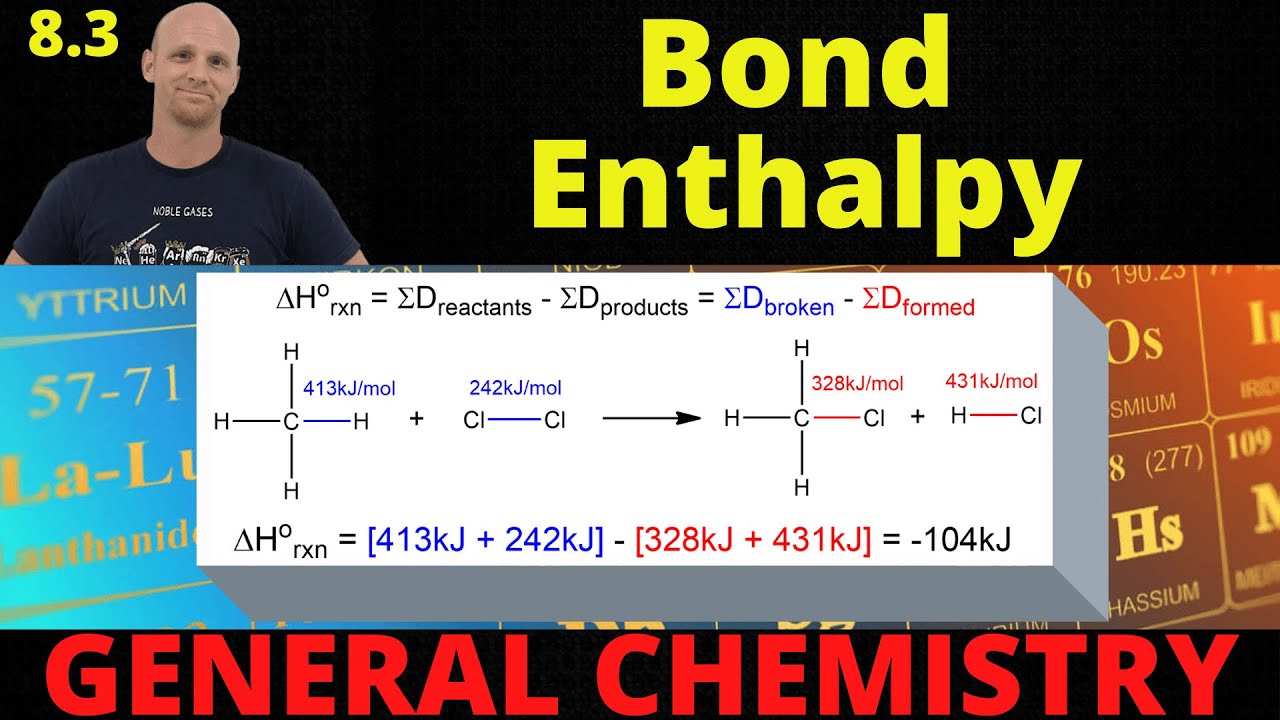
Example: CH4 + Cl2 → CH3Cl + HCl
Draw out the Lewis structures for every species so you can identify all bonds being broken and formed. When coefficients are greater than one, draw each molecule individually to avoid missing bonds.
Method 1: All Reactant Bonds Minus All Product Bonds
Identify every bond on each side of the equation:
- Reactants: 4 C–H bonds + 1 Cl–Cl bond
- Products: 3 C–H bonds + 1 C–Cl bond + 1 H–Cl bond
ΔH = [1652 + 242] − [1239 + 328 + 431]
ΔH = 1894 − 1998
ΔH = −104 kJ
Method 2: Only Bonds Broken Minus Bonds Formed (Faster)
Notice that 3 of the 4 C–H bonds in the reactants also appear in the products. Adding them on one side only to subtract them on the other is redundant. A faster approach: identify only the bonds that change.
- Bonds broken: 1 C–H bond + 1 Cl–Cl bond
- Bonds formed: 1 C–Cl bond + 1 H–Cl bond
ΔH = 655 − 759
ΔH = −104 kJ
Same Answer, Simpler Math
Both methods yield −104 kJ. The simplified approach is faster when you can quickly spot which bonds change, but the comprehensive method is more systematic and harder to mess up. Use whichever feels more reliable on exam day.
Interpreting the Result
The negative ΔH indicates an exothermic reaction—more energy is released forming new bonds than is absorbed breaking old ones. Remember, this value is an approximation because bond enthalpy values are averages. Calculating ΔH via Hess's law or enthalpies of formation would give a slightly different, more precise answer.
Bond Strength Trends in the Periodic Table
Across a Period: Electronegativity Determines Bond Strength
When comparing bonds to hydrogen across the same period—C–H, N–H, O–H, F–H—bond strength increases as the partner atom becomes more electronegative. The O–H bond (463 kJ/mol) is stronger than the N–H bond (391 kJ/mol) because oxygen is more electronegative than nitrogen.
Both atomic size and electronegativity influence bond strength, but atoms within the same period are similar in size. With that variable roughly constant, electronegativity becomes the determining factor: the more electronegative the atom, the stronger the bond and the larger the bond enthalpy.
Down a Group: Atomic Size Determines Bond Strength
When comparing bonds within the same group—H–F, H–Cl, H–Br, H–I—bond strength decreases going down the group. The H–F bond is the shortest and strongest because fluorine is the smallest halogen. As atomic size increases down the group, bonds become longer, weaker, and have smaller bond enthalpies.
Bond Strength Trend Summary
| Comparison | Dominant Factor | Trend |
|---|---|---|
| Across a period (same row) | Electronegativity | More electronegative → stronger bond |
| Down a group (same column) | Atomic size | Smaller atom → shorter, stronger bond |
Single, Double, and Triple Bond Enthalpies
Between the same 2 atoms, bond strength increases with bond order: a single bond is weaker than a double bond, which is weaker than a triple bond. However, doubling or tripling the bond order does not simply double or triple the bond enthalpy—each bond type must be looked up individually.
Nitrogen–Nitrogen Bond Enthalpies by Bond Order
| Bond Type | Bond Enthalpy (kJ/mol) |
|---|---|
| N–N (single) | 163 |
| N=N (double) | 418 |
| N≡N (triple) | 941 |
The triple bond (941 kJ/mol) is far more than 3 times the single bond (163 kJ/mol). This disproportionate increase has real consequences in calculations—you cannot simply add incremental "extra bond" values when the bond order changes.
Example: N2H4 + O2 → N2 + 2H2O
| Bond Enthalpies (kJ/mol) | |
|---|---|
| N–H | 391 |
| O–H | 463 |
| O=O | 495 |
| N–N | 163 |
| N≡N | 941 |
Setting Up the Bond Enthalpy Calculation
Draw Lewis structures for every molecule. When a coefficient is greater than one (like the 2 water molecules here), draw each copy separately. A common mistake is drawing only 1 water molecule and accounting for just 2 O–H bonds instead of 4.
In this reaction, every bond in the reactants is broken and every bond in the products is formed—there are no "carried over" bonds. Even though the nitrogen atoms remain bonded to each other throughout, the bond type changes from a single bond (in N2H4) to a triple bond (in N2), so you must use the specific bond enthalpy for each bond type. This is a key difference from the previous example.
You Cannot Add Incremental Bond Enthalpy Values
When a bond changes from single to triple between the same 2 atoms, you must use the tabulated triple-bond value—not the single-bond value plus 2 extra bonds. Each bond type (single, double, triple) has its own distinct enthalpy value that must be looked up separately.
Performing the Calculation
- Reactant bonds (broken): 1 N–N single (163) + 4 N–H (391 each) + 1 O=O double (495)
- Product bonds (formed): 1 N≡N triple (941) + 4 O–H (463 each)
ΔH = [163 + 1564 + 495] − [941 + 1852]
ΔH = 2222 − 2793
ΔH = −571 kJ
Check Your Coefficients
Drawing both water molecules separately makes it easy to count all 4 O–H bonds. Relying on the formula alone without drawing Lewis structures is a recipe for missed bonds and incorrect ΔH values.
Comparing the 2 Formulas: Bond Enthalpy vs. Enthalpy of Formation
The direction of the formula depends on what the thermochemical data describes. Understanding why the formulas differ will keep you from mixing them up on an exam.
Why Enthalpy of Formation Uses Products Minus Reactants
Enthalpy of formation (ΔHf) values describe the energy change when a substance is formed from its elements in their standard states. In a reaction, the products are what's being formed, so their ΔHf values go in directly. The reactants are being "un-formed" (broken apart), so their values are subtracted.
Why Bond Enthalpy Uses Reactants Minus Products
Bond enthalpy (bond dissociation energy) values describe the energy to break a bond. Bonds are broken in the reactants, so those values go in directly. Bonds in the products are being formed (the opposite of breaking), so their values are subtracted.
Side-by-Side Comparison: All 3 Methods
| Method | Formula | Result Type |
|---|---|---|
| Hess's Law | Sum of manipulated reaction ΔH values | Exact |
| Enthalpy of Formation | Products − Reactants | Exact |
| Bond Enthalpy | Reactants − Products | Approximation |
Identify Your Data First
Before writing any formula, determine what kind of values you've been given. If the problem provides ΔHf values, use products minus reactants. If it provides bond enthalpy (bond dissociation energy) values, use reactants minus products. Mixing up the formula direction is one of the most common errors on general chemistry exams.
8 Key Takeaways
- Bond enthalpy (bond dissociation energy) is the energy required to break one mole of a bond in the gas phase—an endothermic process. Forming a bond releases energy (exothermic).
- Bond enthalpy values are averages across many molecules, so calculations yield approximations rather than exact ΔH values—unlike Hess's law and enthalpy of formation.
- The bond enthalpy formula is Σ(reactant bonds) − Σ(product bonds). Do not manually negate the product values—the subtraction already handles the sign change.
- You can simplify calculations by identifying only the bonds that change (broken in reactants, formed in products), skipping bonds that appear unchanged on both sides.
- Across a period, more electronegative atoms form stronger bonds. Down a group, smaller atoms form shorter, stronger bonds.
- Bond strength increases with bond order (single < double < triple), but not proportionally—each bond type requires its own tabulated bond enthalpy value.
- Enthalpy of formation uses products minus reactants; bond enthalpy uses reactants minus products. Always identify which thermochemical data you have before choosing a formula.
- Drawing Lewis structures for every molecule (including separate copies for coefficients greater than 1) is essential for counting bonds correctly.